
Functional Systems Assessment™ Training Pathway for Manual Therapists
Learn how to unwind chronic tension, identify the body's priorities, protect your career from burnout, and help clients achieve lasting results.
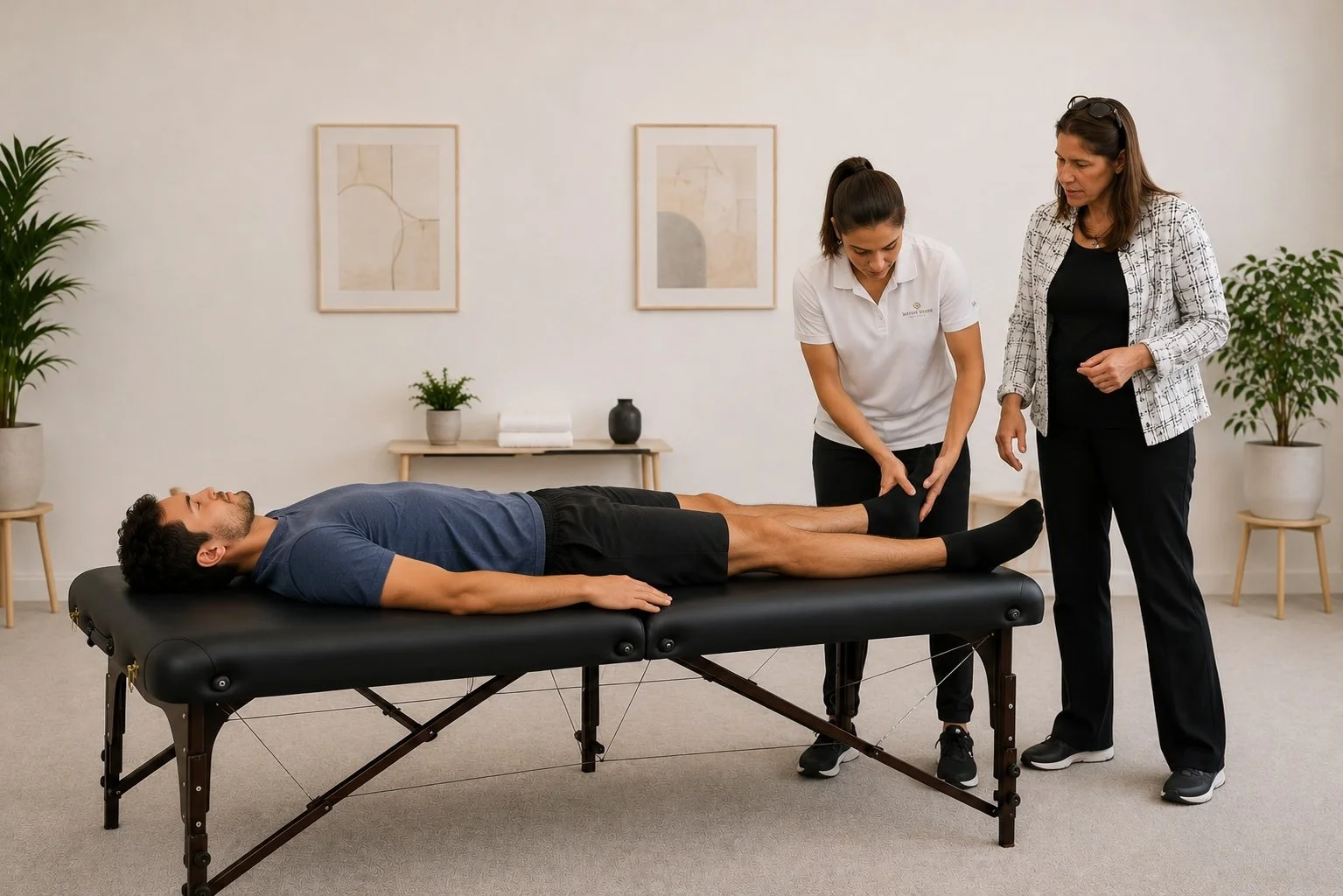
Become a Clinical Master in 7 Progressive Steps
What Is the Clinical Mastery Program?
Most therapists spend their careers learning techniques to enhance clinical skills and reduce physical burnout, but the challenge is knowing when to use them and how to create a personal treatment approach.
The Clinical Mastery Program was developed after 30 years of clinical practice, teaching, and mentoring therapists. It is designed to help Manual Osteopaths, Registered Massage Therapists, and other manual therapists improve assessment skills, refine palpation, reduce personal physical strain, and achieve better clinical outcomes.
At the heart of the program are two core concepts:
Functional Systems Assessment™ is a clinical decision-making framework that helps therapists identify the body's priorities, recognize compensation patterns, and determine where to begin treatment. Rather than replacing your current assessment methods, it enhances them by providing a clear system for organizing clinical findings and identifying the factors most likely contributing to pain, dysfunction, and compensation.
Tissue Melting™ is both a palpation skill and treatment approach designed to help therapists develop greater sensitivity, precision, and confidence with their hands. While there are specific techniques to learn, the true value of Tissue Melting™ lies in what it teaches you to feel. Through guided practice, therapists learn how to recognize tissue restrictions, compensation patterns, treatment priorities, and subtle changes within the body that often go unnoticed.
As students progress through the program, Tissue Melting™ evolves from a technique into a way of working. Rather than adding another modality to your toolbox, it becomes the foundation that helps unify the skills you already possess. Whether your background is massage therapy, osteopathy, cranial work, visceral manipulation, muscle energy, joint mobilization, or other manual therapy approaches, Tissue Melting™ helps blend those techniques into one seamless and effective treatment experience.
Our Practitioners End Results
"I was working far too hard before."
"I finally understand where to start my treatments."
"I no longer feel stuck with difficult cases."
"I know exactly when to use the techniques I already know."
"I'm getting better results with less effort."
"I'm no longer exhausted at the end of the week."
"My treatments feel more connected and purposeful."
"This is the missing link I wish I had learned years ago."
Your Path to Clinical Mastery
Each step builds upon the last, helping you develop the assessment, palpation, clinical reasoning, and treatment skills needed to achieve better outcomes, reduce physical strain, and create a more sustainable practice.
Step 1: Start Using the Principles Today
Free Online Introduction: The Foundations of Osteopathic Thinking
Discover the principles that inspired Andrew Taylor Still to create osteopathy and why these concepts remain relevant today. Learn how the body functions as an interconnected system, why symptoms often persist despite treatment, and how assessment plays a critical role in achieving lasting results.
This introductory course explores:
➝ What osteopathy is and why it was created
➝ The difference between treating symptoms and identifying contributors
➝ Why some therapists achieve better results with less effort
➝ The role of assessment in clinical decision-making
➝ How Functional Systems Assessment™ helps therapists identify the body's priorities
➝ Why Tissue Melting™ became the foundation of our training pathway
➝ How therapist longevity, client outcomes, and clinical confidence are connected
By the end of this training, you will understand why assessment begins before you ever touch a client and why knowing where to start is often the most important skill a therapist can develop.
Step 2: Learn to Listen
Tissue Melting™ Foundations & Functional Systems Assessment™
This foundational course is the heart of the Clinical Mastery Program. Learn the assessment, palpation, and listening skills needed to identify the body's priorities and make confident clinical decisions. Using Tissue Melting™ as our foundational framework, you will develop the hands and awareness required for advanced cranial, visceral, and osteopathic training. If you want to become a clinical master, it starts here.
Step 3: Expand Your Palpation
Advanced Tissue Melting™
Once you have begun applying the foundational techniques in practice, it is time to expand your skills to the entire body. In this course, you will learn a full-body Tissue Melting™ protocol that will help you recognize deeper compensation patterns, improve treatment flow, and refine your palpation skills. By the end of this training, your hands will be prepared to appreciate the subtle relationships required for advanced visceral manipulation and osteopathic assessment.
Step 4: Understand the Visceral System
Visceral Integration
Whether you are new to visceral manipulation or an experienced osteopath looking to refine your skills, this course will help you connect the dots between organ function, movement, posture, pain, and compensation patterns. Rather than overwhelming you with dozens of techniques, we focus on understanding when and why visceral work matters. Learn how to integrate visceral assessment and treatment into common clinical presentations such as low back pain, shoulder pain, and restricted range of motion, making visceral work practical, effective, and easy to apply.
Step 5: Master the Cranial System
Cranial Integration
By the time you reach cranial training, your palpation skills have become highly refined, making cranial work much easier to understand and feel. Learn to recognize cranial movement, pressure patterns, restrictions, and fluid dynamics while developing a deeper appreciation for the body's ability to adapt and heal. As your perception continues to grow, you will begin recognizing how stress, emotions, and long-standing patterns can influence tissue tension, recovery, and overall function. This course transforms cranial osteopathy from a technique into a practical clinical skill.
Step 6: Influence Change
Joint Mobilization & Muscle Energy
Joint Mobilization and Muscle Energy are some of the most effective tools in osteopathy, which is why they are taught later in the program. By this stage, you will have developed the assessment, palpation, and listening skills needed to understand when these techniques are appropriate and how to modify them for the individual in front of you.
Many therapists apply these techniques mechanically. In this course, you will learn how to listen to the tissues as you apply them, allowing for greater precision and longer-lasting results. Often used for maintenance care, mobility restoration, and shorter treatment sessions, these techniques become significantly more effective when the deeper restrictions and compensation patterns have already been addressed.
This course teaches you how to integrate Joint Mobilization and Muscle Energy into a complete treatment strategy, helping create changes that last longer and supporting the work of chiropractors, massage therapists, and osteopaths alike.
Step 7: Stack and Integrate
Advanced Clinical Integration
This is where everything comes together.
Most therapists learn techniques one at a time. Advanced therapists learn how to blend them into a seamless treatment experience. In this final stage, you will learn how to "stack" assessments, techniques, and clinical reasoning into a treatment strategy that is both efficient and highly individualized.
Rather than using techniques in isolation, you will discover how to combine Tissue Melting™, visceral work, cranial osteopathy, joint mobilization, muscle energy, and your existing skill set into one cohesive approach. More importantly, you will learn when to layer techniques, when to simplify, and how to adapt your treatment plan based on what the body is communicating.
This is often the missing link between knowing techniques and mastering them. As your palpation skills continue to evolve, you will gain the confidence to integrate new discoveries, refine your clinical style, and develop a treatment approach that is uniquely your own.
The result is greater efficiency, clearer clinical decision-making, and the ability to create treatment experiences that clients consistently describe as different, thorough, and highly effective.
Certification Options
Functional Systems Assessment™ & Tissue Melting™ Certification
Demonstrate competency in assessment, palpation, clinical reasoning, and treatment integration. Successful graduates may apply for certification and a practitioner listing on our website.
Looking for More?
RMT to Manual Osteopath Bridge Program
For Registered Massage Therapists seeking a pathway into Manual Osteopathy, the Clinical Mastery Program provides the foundation for advanced osteopathic training through the ERA Bridge Program.
Most Common Questions
-
The first three courses are designed to be taken in sequence, as each one builds upon the assessment, palpation, and listening skills developed in the previous course. These foundational classes provide the framework needed to get the most out of the advanced training.
After completing the first three courses, Cranial Integration, Visceral Integration, and Joint Mobilization & Muscle Energy may be taken in any order. While there is a recommended learning sequence based on how most students develop their skills most effectively, we recognize that every therapist's learning journey is unique.
-
Each module consists of four days of hands-on training and is designed to provide practical skills that can be immediately integrated into clinical practice.
Tuition: $1,600 per module
Association member discounts and early registration discounts are often available. Please check individual course listings for current pricing and promotional offers.
Our goal is to make advanced clinical training accessible while providing a high level of personalized instruction, hands-on practice, and mentorship throughout the learning process.
-
Yes. One of the primary goals of the Clinical Mastery Program is to help therapists work more efficiently, rely less on force, and create better outcomes without sacrificing their own health and longevity. As your assessment, palpation, and listening skills improve, you will learn how to achieve more with less physical effort, reducing the wear and tear that often leads to therapist burnout.
Unlike many continuing education programs, you will also receive treatments throughout the hands-on training. This allows you to experience the techniques from both the therapist and client perspective while helping your own body unwind years of accumulated tension and compensation.
To maximize hands-on learning time, additional online resources and support materials are provided outside of class. This allows each four-day module to focus on skill development, supervised practice, and refining the clinical skills that are difficult to learn from books or videos alone.
-
Yes. We are actively obtaining Continuing Education Unit (CEU) approval for associations and provinces that require them. Approved CEUs will be listed on individual course pages as they become available.
If your association is not currently listed, please contact us at info@echoridgeacademy.com. We are continually expanding our approvals and will gladly explore adding your association to our approved provider list whenever possible.